
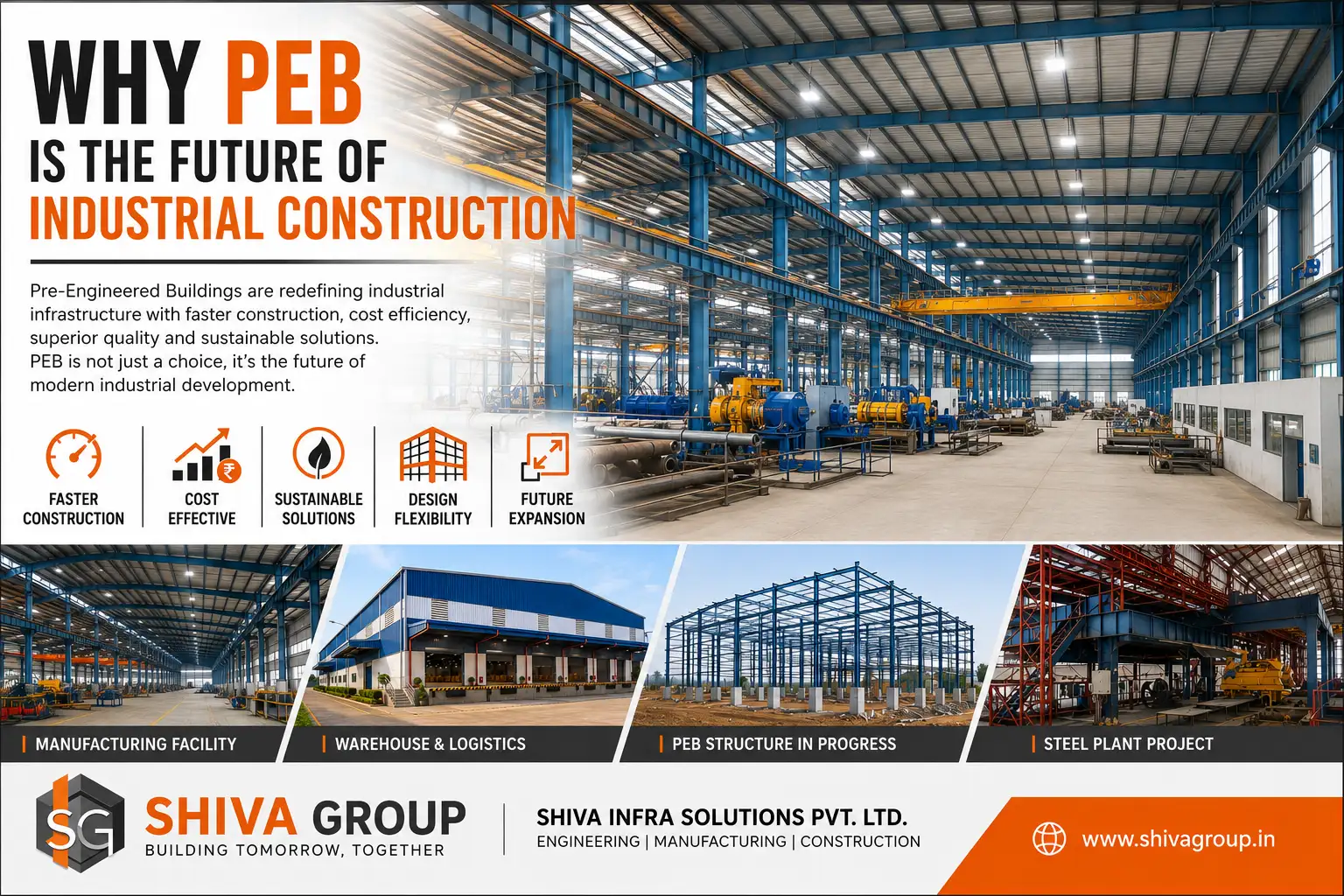
Introduction : Why PEB is the Future of Industrial Construction
Industrial construction has always been the backbone of economic growth and industrial development. Manufacturing plants, warehouses, logistics parks, steel plants, power facilities, food processing units, automobile factories, and distribution centers all depend on robust infrastructure to support operations and expansion. However, the expectations from industrial buildings have changed significantly over the last decade.
Today’s businesses require faster project delivery, lower capital expenditure, higher operational efficiency, sustainability, flexibility for future expansion, and infrastructure that can adapt to changing business requirements. Traditional construction methods often struggle to meet these modern expectations due to longer construction periods, higher labor dependency, material wastage, and increasing project costs.
The growing adoption of PEB in Industrial Construction is being driven by the need for faster project execution, optimized project costs, and scalable infrastructure solutions. Industries across manufacturing, warehousing, logistics, and heavy engineering sectors are increasingly investing in PEB technology to support long-term growth and operational efficiency.
This shift in industry expectations has accelerated the adoption of Pre-Engineered Buildings, commonly known as PEB structures.
Across India and global markets, Pre-Engineered Buildings are transforming the way industries approach construction projects. From manufacturing facilities to mega warehouses and logistics hubs, PEB has emerged as the preferred choice for organizations looking for smarter, faster, and more efficient industrial infrastructure solutions.
The question is no longer whether industries should adopt PEB construction.
The question today is why PEB is the future of industrial construction.
Understanding Pre-Engineered Buildings (PEB)
A Pre-Engineered Building is a steel structure that is engineered, designed, manufactured, and fabricated in a controlled manufacturing facility before being transported to the project site for assembly and erection.
Unlike conventional construction where fabrication activities happen at the construction site, PEB structures are designed using advanced engineering software and precision manufacturing techniques that optimize every structural component based on actual load requirements and project specifications.
Every component including columns, rafters, purlins, girts, roofing systems, wall cladding, and accessories is manufactured with precision and delivered ready for installation.
This approach significantly reduces construction timelines while improving quality, efficiency, and cost control.
PEB structures are widely used for:
- Manufacturing facilities
- Warehouses
- Logistics parks
- Distribution centers
- Steel plants
- Power plants
- Automobile manufacturing units
- Food processing facilities
- Cold storage units
- Aircraft hangars
- Commercial complexes
- Institutional buildings
- Infrastructure projects
The versatility of PEB makes it suitable for almost every industrial application.
The Growing Demand for Industrial Infrastructure
India is currently experiencing one of the largest industrial expansion phases in its history.
Government initiatives such as Make in India, Production Linked Incentive schemes, industrial corridors, dedicated freight corridors, smart logistics parks, and infrastructure investments are driving demand for industrial facilities across sectors.
Industries such as:
- Steel and metals
- Renewable energy
- Pharmaceuticals
- Automotive manufacturing
- Warehousing and logistics
- Food processing
- Heavy engineering
- Consumer goods manufacturing
- E-commerce fulfillment
are expanding rapidly and require modern infrastructure solutions that can be delivered quickly and efficiently.
Traditional construction methods often become bottlenecks due to lengthy project schedules and rising construction costs.
PEB construction solves these challenges and supports the pace of industrial growth.
Faster Construction Timelines
One of the biggest reasons why PEB is considered the future of industrial construction is speed.
Time directly impacts business profitability.
Every delay in construction completion means delayed production, delayed warehousing operations, delayed customer deliveries, and delayed revenue generation.
Traditional industrial construction projects often take several months or even years due to site fabrication activities, labor dependencies, weather interruptions, and coordination challenges.
PEB construction follows an entirely different approach.
While civil foundation work progresses at the site, structural components are simultaneously manufactured in factories. Once the foundations are ready, the fabricated components are delivered to the site and assembled rapidly.
This parallel execution model significantly reduces project duration.
Many industrial projects witness construction timeline reductions of 30 to 50 percent compared to conventional methods.
For industries operating in competitive markets, faster commissioning can create substantial commercial advantages.
A manufacturing facility that begins production three months earlier gains additional production capacity, revenue opportunities, and market access ahead of competitors.
This speed advantage alone makes PEB a preferred construction solution for modern industries.
Benefits of PEB Structures
The growing popularity of Pre Engineered Buildings is largely due to the multiple advantages they offer over conventional construction methods. From faster execution and lower costs to sustainability and flexibility, the benefits of PEB structures make them an ideal choice for modern industrial development.
Cost Efficiency Without Sacrificing Quality
Cost optimization remains one of the biggest priorities in industrial project development.
Businesses constantly seek ways to reduce capital expenditure without compromising quality or operational performance.
PEB construction achieves this balance exceptionally well.
Several factors contribute to cost savings:
- Optimized steel usage.
- Reduced material wastage.
- Lower labor requirements.
- Faster project completion.
- Reduced financing costs.
- Lower project management expenses.
- Minimal rework during construction.
Advanced structural engineering ensures that every steel member is designed according to actual load requirements rather than conservative assumptions.
This optimization reduces unnecessary steel consumption and improves overall project economics.
Factory-controlled manufacturing also minimizes wastage, unlike traditional site fabrication where losses can be significant.
Over the lifecycle of the building, lower maintenance requirements further improve return on investment.
Precision Engineering and Better Quality Control
Industrial facilities require high standards of quality and reliability.
PEB manufacturing takes place in controlled factory environments where every component undergoes strict quality inspections and dimensional checks.
Advanced machinery and automated manufacturing systems ensure precision fabrication that is difficult to achieve with conventional site-based construction methods.
Benefits include:
- Better dimensional accuracy.
- Improved structural integrity.
- Consistent manufacturing quality.
- Reduced human error.
- Better finishing standards.
- Faster installation accuracy.
Because components arrive ready for installation, the probability of site modifications and fabrication errors decreases significantly.
This translates into smoother project execution and improved long-term building performance.
Design Flexibility for Modern Businesses
Industrial requirements evolve continuously.
A factory established today may require additional production lines in the future. Warehousing operations may need increased storage capacity. Logistics operators may expand their fleet and handling infrastructure.
Traditional construction often makes future modifications difficult and expensive.
PEB structures offer exceptional flexibility and scalability.
Some key advantages include:
- Large clear spans without intermediate columns.
- Easy future expansion possibilities.
- Flexible layout configurations.
- Crane integration capabilities.
- Multiple roofing and cladding options.
- Architectural customization opportunities.
Large clear spans improve operational efficiency by allowing unrestricted movement of machinery, vehicles, and material handling equipment.
The ability to expand existing facilities without major structural modifications is another major advantage for growing businesses.
Sustainability and Environmental Responsibility
Sustainability is no longer an optional objective.
Investors, regulators, customers, and businesses increasingly expect environmentally responsible practices across every stage of industrial development.
PEB aligns naturally with sustainability objectives.
Steel is one of the most recyclable construction materials in the world.
A significant percentage of structural steel used in PEB projects can be recycled and reused at the end of the building’s lifecycle.
Additional environmental benefits include:
- Reduced construction waste.
- Lower energy consumption during fabrication.
- Reduced transportation requirements.
- Lower site pollution.
- Reduced water usage.
- Better resource utilization.
Modern insulation systems can also improve energy efficiency and reduce operational costs associated with cooling and heating.
Organizations pursuing green building certifications often find PEB solutions highly compatible with sustainability targets.
Superior Structural Performance
Industrial buildings operate under demanding conditions.
They must withstand:
- Heavy equipment loads.
- Crane operations.
- Dynamic manufacturing activities.
- High wind pressures.
- Seismic events.
- Temperature variations.
PEB structures are designed using advanced engineering software that accurately analyzes structural behavior under multiple loading scenarios.
This enables engineers to optimize member sizes while maintaining high safety standards.
The result is a structure that offers:
- High strength-to-weight ratio.
- Better load distribution.
- Improved durability.
- Long service life.
- Lower maintenance costs.
The engineering precision of PEB structures ensures reliability even in challenging environmental and operational conditions.
Reduced Foundation Costs
One of the lesser discussed advantages of PEB construction is reduced foundation requirements.
Steel structures are significantly lighter than conventional concrete structures.
The lower dead load reduces foundation sizes and associated civil construction costs.
This offers multiple benefits:
- Lower excavation requirements.
- Reduced concrete consumption.
- Faster foundation construction.
- Lower overall project cost.
For large industrial developments where foundation costs represent a significant portion of the budget, these savings become substantial.
Improved Safety During Construction
Construction safety remains a major concern across industrial projects.
Traditional construction often involves extensive site fabrication activities, heavy manual labor, and prolonged exposure to hazardous working conditions.
PEB construction improves site safety by shifting fabrication activities to controlled manufacturing facilities.
Because components arrive ready for assembly:
- On-site welding requirements are minimized.
- Material handling activities reduce.
- Construction duration decreases.
- Labor exposure reduces.
Shorter project durations and reduced site complexity contribute to improved safety performance.
Supporting Smart Manufacturing Facilities
The future of manufacturing is increasingly driven by automation, robotics, data analytics, and Industry 4.0 technologies.
Modern factories require infrastructure that supports these technological advancements.
PEB structures provide:
- Large uninterrupted floor spaces.
- Flexible equipment layouts.
- Efficient utility integration.
- Better workflow planning.
- Easy future expansion.
These characteristics make PEB the ideal infrastructure solution for smart manufacturing facilities.
As automation adoption increases across industries, the importance of flexible industrial infrastructure will continue to grow.
Warehousing and Logistics Growth is Fueling PEB Adoption
India’s logistics and warehousing sector is experiencing unprecedented expansion.
The rise of e-commerce, organized retail, third-party logistics providers, and supply chain modernization is creating enormous demand for warehouses and fulfillment centers.
Warehousing projects require:
- Large clear spans.
- Faster construction schedules.
- Cost-effective solutions.
- Scalability for future growth.
PEB structures satisfy all these requirements.
As logistics infrastructure continues to expand, PEB adoption will accelerate further.
PEB and Renewable Energy Infrastructure
The renewable energy sector is another major driver of industrial construction demand.
Solar manufacturing units, battery plants, wind component facilities, and energy storage systems require modern industrial infrastructure.
PEB structures offer the speed and flexibility required to support rapidly growing renewable energy investments.
The compatibility of steel construction with sustainable development objectives further strengthens the role of PEB in this sector.
Why Businesses Prefer PEB Over Conventional Construction
Businesses increasingly choose PEB because it offers a combination of advantages that conventional construction struggles to match.
These advantages include:
- Faster project completion.
- Lower project cost.
- Better quality control.
- Reduced maintenance expenses.
- Improved sustainability performance.
- Flexible expansion opportunities.
- Better structural efficiency.
- Improved project predictability.
For decision makers evaluating long-term infrastructure investments, these benefits make PEB the logical choice.
The Importance of Choosing the Right PEB Partner
While PEB technology offers tremendous advantages, project success depends heavily on the expertise of the engineering and execution partner.
Selecting the right PEB Building Manufacturer in India is essential for ensuring project quality, structural reliability, and timely execution. Businesses should evaluate engineering capabilities, manufacturing infrastructure, project experience, and installation expertise before finalizing a partner.
A reliable PEB company should possess strengths in:
- Structural engineering.
- Manufacturing quality.
- Project management.
- Installation capabilities.
- Industry experience.
- Technical support.
The right partner not only delivers a building but also contributes to operational efficiency, future scalability, and long-term value creation.
Among the companies contributing to India’s industrial growth through advanced PEB solutions is Shiva Infra Solutions Pvt Ltd.
With expertise in industrial infrastructure, engineering solutions, and turnkey project execution, the company has developed capabilities across manufacturing facilities, steel plants, warehouses, infrastructure projects, and industrial developments across India while also gaining experience through projects in international markets.
Its approach reflects the evolving direction of the PEB industry where engineering precision, quality manufacturing, project efficiency, and customer-focused execution define success.
The Future of Industrial Construction is Already Here
The industrial construction industry is moving toward solutions that deliver speed, efficiency, sustainability, flexibility, and long-term value.
Pre-Engineered Buildings successfully combine all these advantages into a single construction methodology.
What was once considered an alternative construction system has now become the preferred choice for industrial developers across sectors.
As industries continue to invest in manufacturing expansion, logistics infrastructure, renewable energy projects, and industrial modernization, the demand for PEB solutions will continue to increase.
The businesses that adopt this technology today position themselves to compete more effectively tomorrow.
Conclusion
Industrial construction is entering a new era.
The demands of modern businesses require infrastructure that can be delivered quickly, operate efficiently, support sustainability goals, and adapt to future expansion.
Pre-Engineered Buildings meet all these expectations.
They offer faster construction timelines, lower project costs, superior quality control, flexible designs, sustainability benefits, and long-term operational value.
These advantages explain why developers, manufacturers, logistics operators, and industrial investors are increasingly choosing PEB over conventional construction methods.
The future industrial landscape will be defined by smarter buildings, faster execution, and more efficient use of resources.
Pre-Engineered Buildings are not simply a trend in industrial development.
They represent the future of industrial construction itself.
Frequently Asked Questions
1. What is a Pre-Engineered Building (PEB)?
A Pre-Engineered Building is a steel structure that is designed, manufactured, and fabricated in a factory before being assembled at the project site. It offers faster construction and better cost efficiency compared to traditional construction methods.
2. Why is PEB considered the future of industrial construction?
PEB provides faster project execution, reduced costs, sustainability benefits, design flexibility, and superior structural performance, making it the preferred choice for modern industrial infrastructure.
3. What are the advantages of PEB over conventional construction?
The major advantages include shorter construction timelines, optimized material usage, lower labor requirements, easier expansion possibilities, and reduced maintenance costs.
4. Which industries commonly use PEB structures?
PEB structures are widely used in manufacturing, warehousing, logistics, automotive, food processing, renewable energy, pharmaceuticals, steel plants, and infrastructure projects.
5. Are PEB buildings cost effective?
Yes. PEB buildings reduce construction costs through optimized steel consumption, faster completion schedules, lower labor dependency, and reduced maintenance expenses.
6. Can PEB structures be expanded in the future?
Yes. One of the biggest advantages of PEB is the ability to expand the building in phases without major structural modifications.
7. How long does it take to complete a PEB project?
Project duration varies depending on size and complexity, but PEB projects are generally completed 30 to 50 percent faster than conventional industrial construction projects.
8. Are PEB buildings suitable for warehouse construction?
Yes. Warehouses benefit significantly from PEB due to large clear spans, faster construction, lower costs, and easy scalability.
9. Is PEB construction environmentally friendly?
Yes. Steel is recyclable, material wastage is minimal, and factory-controlled manufacturing improves resource efficiency, making PEB a sustainable construction solution.
10. How do I choose the right PEB company in India?
Businesses should evaluate engineering expertise, manufacturing capabilities, project experience, installation support, quality standards, and after-sales service before selecting a PEB partner.