
Introduction
Industrial projects are among the largest financial investments made by businesses, government organizations, and infrastructure developers. Whether it’s a steel plant, power plant, manufacturing facility, logistics park, warehouse, cement plant, or industrial township, every project requires meticulous planning, technical expertise, and precise execution. Even a minor mistake in engineering design or project planning can result in significant financial losses, construction delays, safety concerns, and long-term operational inefficiencies.
Despite investing substantial amounts in construction, equipment, and manpower, many organizations underestimate the value of professional engineering consultancy during the early stages of a project. They often perceive consultancy as an additional expense rather than recognizing it as a strategic investment that can prevent costly mistakes and maximize returns.
The reality is quite different. A well-executed engineering consultancy process can save millions by optimizing designs, reducing material consumption, preventing rework, improving construction efficiency, ensuring regulatory compliance, and minimizing project risks. Professional engineering consultants evaluate every technical aspect of a project before construction begins, enabling businesses to make informed decisions that lead to better financial and operational outcomes.
In today’s competitive industrial landscape, where project timelines are tighter, regulations are more stringent, and material costs continue to fluctuate, engineering consultancy has become an essential component of successful project execution. Companies that invest in experienced engineering consultants are better equipped to complete projects on time, within budget, and with higher quality standards.
This article explores how engineering consultancy contributes to significant cost savings throughout the lifecycle of industrial projects and why it has become a critical factor in achieving long-term project success.
What is Engineering Consultancy?
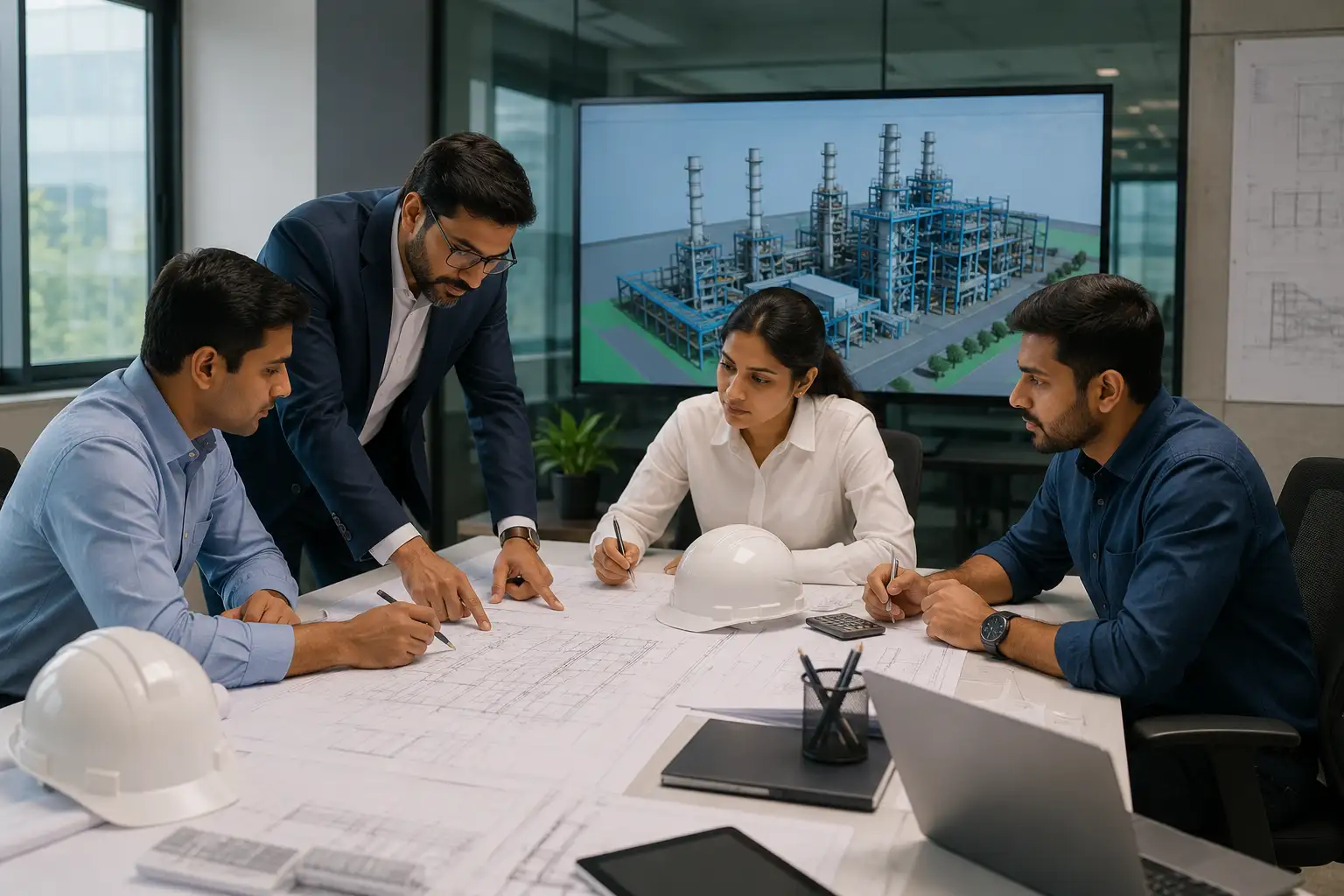
Engineering consultancy is a specialized professional service that provides technical expertise, planning, design, analysis, and project support throughout the lifecycle of industrial and infrastructure projects. Unlike construction contractors, who primarily focus on executing the work on-site, engineering consultants concentrate on developing efficient, safe, and economically viable engineering solutions before construction begins and throughout project execution.
An engineering consultancy works closely with project owners, architects, contractors, equipment suppliers, and regulatory authorities to ensure that every engineering decision aligns with project objectives, technical standards, safety requirements, and budget constraints.
Typical engineering consultancy services include:
- Feasibility studies and technical assessments
- Conceptual engineering and planning
- Structural engineering and analysis
- Detailed engineering
- Steel structure design
- Foundation engineering
- Industrial plant layout planning
- Shop drawings
- Design optimization
- Procurement support
- Construction supervision
- Quality assurance
- Technical documentation
- Project management support
These services help organizations reduce uncertainty, improve decision-making, and establish a strong technical foundation before investing significant resources in construction activities.
Why Industrial Projects Fail Financially
One of the biggest misconceptions in industrial construction is that cost overruns are primarily caused by increasing material prices. While fluctuations in steel, cement, and equipment costs certainly affect project budgets, most financial losses originate much earlier during planning and engineering.
Several common issues contribute to project failures.
Inadequate Project Planning
Many industrial projects begin with incomplete project definitions, unrealistic budgets, or insufficient engineering investigations. Without comprehensive planning, unexpected technical challenges arise during construction, forcing teams to redesign structures, modify layouts, or delay execution.
Every design revision increases costs while reducing overall productivity.
Professional engineering consultants conduct detailed feasibility studies, evaluate site conditions, assess technical risks, and establish realistic project plans before construction begins.
Design Errors
Engineering design mistakes often become visible only after construction has started.
Incorrect structural calculations, improper equipment loading assumptions, insufficient foundation capacity, or inaccurate dimensional coordination can require expensive modifications.
For example, discovering that a production building cannot safely support overhead cranes after construction has started can require extensive structural strengthening, significantly increasing project costs and delaying operations.
Comprehensive engineering reviews help identify these issues before they impact construction.
Material Overdesign
Safety should never be compromised. However, many projects unknowingly waste large amounts of steel and concrete because structures are excessively overdesigned.
Using larger beams, thicker columns, or unnecessary reinforcement may increase safety margins slightly but often leads to substantial material costs without delivering proportional benefits.
Experienced structural engineers perform optimization studies to achieve the ideal balance between structural performance, safety, and cost efficiency.
Even reducing structural steel consumption by just five percent in a large industrial project can translate into savings worth millions of rupees.
Poor Coordination Between Disciplines
Industrial projects involve multiple engineering disciplines, including civil, structural, mechanical, electrical, piping, HVAC, instrumentation, and fire protection.
Without proper coordination, clashes become inevitable.
Examples include:
- Structural columns interfering with process pipelines
- Electrical cable trays conflicting with ventilation systems
- Equipment foundations overlapping underground utilities
- Crane beams obstructing maintenance access
Resolving these conflicts during construction is expensive and time-consuming.
Engineering consultancy integrates multidisciplinary coordination before construction starts, reducing rework and improving project efficiency.
Delayed Decision Making
Industrial projects frequently experience delays because technical decisions are postponed until construction has already begun.
Questions such as equipment placement, utility routing, structural modifications, and procurement specifications should be resolved during engineering rather than during execution.
Engineering consultants provide clear technical documentation that enables faster decision-making and smoother project execution.
The Hidden Cost of Poor Engineering Decisions
Many organizations only calculate direct construction costs while ignoring the indirect financial impact of engineering mistakes.
Poor engineering decisions often result in:
- Rework during construction
- Idle labor costs
- Equipment rental extensions
- Delayed project commissioning
- Increased financing costs
- Additional contractor claims
- Procurement delays
- Material wastage
- Regulatory penalties
- Operational inefficiencies after project completion
These hidden costs frequently exceed the original engineering consultancy fees several times over.
A professional engineering consultant helps eliminate these avoidable expenses by ensuring technical accuracy from the beginning.
How Engineering Consultancy Saves Millions
Engineering consultancy creates measurable value throughout every phase of an industrial project.
1. Better Feasibility Studies
A successful industrial project begins with a comprehensive feasibility study.
Engineering consultants analyze:
- Site suitability
- Soil conditions
- Utility availability
- Transportation access
- Environmental factors
- Technical risks
- Budget feasibility
- Regulatory requirements
This information enables investors to make informed decisions before committing significant capital.
Poor feasibility studies often lead to expensive design changes, permitting issues, and construction delays that could have been avoided.
2. Optimized Structural Design
Structural optimization is one of the most effective methods of reducing project costs without compromising safety.
Professional structural engineers carefully analyze:
- Dead loads
- Live loads
- Wind loads
- Seismic forces
- Equipment loads
- Crane loads
- Future expansion requirements
Instead of simply increasing structural member sizes, engineering consultants develop efficient structural systems that achieve maximum performance using minimum material.
This approach reduces:
- Steel consumption
- Fabrication costs
- Transportation expenses
- Foundation sizes
- Construction time
The cumulative savings across a large industrial facility can be substantial.
3. Value Engineering: The Smart Way to Reduce Costs Without Compromising Quality
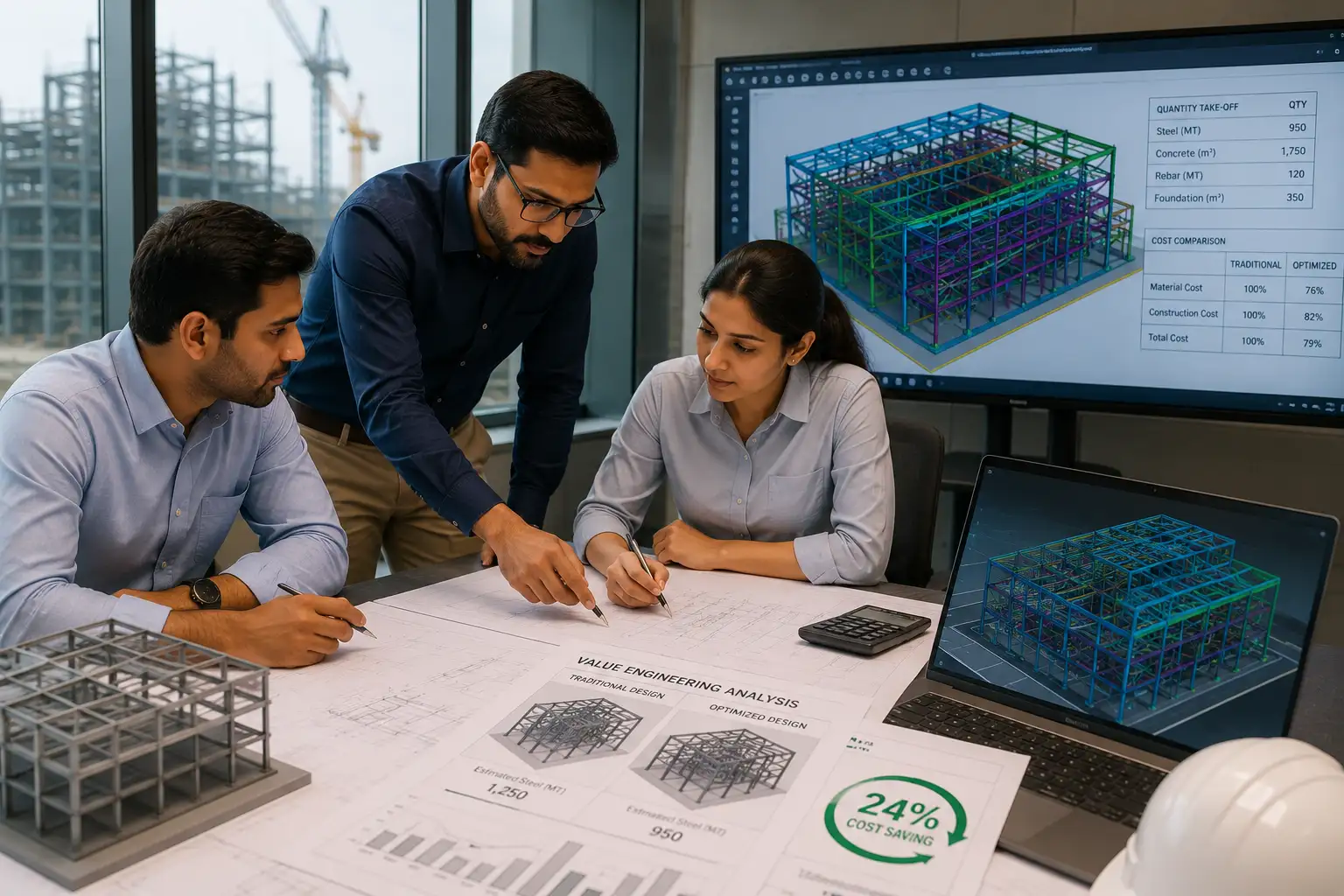
One of the most powerful tools used by engineering consultants is Value Engineering (VE). Contrary to popular belief, value engineering is not about cutting corners or choosing cheaper materials. Instead, it is a structured engineering approach that identifies opportunities to improve functionality, optimize resources, and reduce unnecessary costs while maintaining safety, quality, and performance.
For example, during the design phase of an industrial warehouse, an engineering consultant may recommend an alternative structural framing system that uses less steel while delivering the same load-bearing capacity. Similarly, optimizing the spacing of columns or selecting an efficient foundation type based on soil conditions can significantly reduce material usage and construction time.
Value engineering also evaluates construction methods, equipment layouts, fabrication processes, and maintenance requirements to ensure the project delivers maximum long-term value.
Benefits of Value Engineering
- Reduces capital expenditure
- Minimizes material wastage
- Improves construction efficiency
- Enhances operational performance
- Simplifies maintenance
- Increases return on investment (ROI)
For large industrial projects, these improvements can translate into savings worth several crores over the lifecycle of the facility.
4. Reducing Material Waste Through Smart Engineering
Material costs often account for 50–70% of the total construction budget in industrial projects. Even a small reduction in material consumption can have a significant financial impact.
Engineering consultants use advanced structural analysis software and design optimization techniques to ensure every component is designed efficiently.
Examples include:
- Optimizing beam and column sizes
- Reducing unnecessary reinforcement in foundations
- Standardizing structural members for easier fabrication
- Improving steel connection details
- Optimizing concrete quantities
- Designing efficient drainage and utility layouts
Besides reducing direct material costs, optimized designs also lower transportation expenses, fabrication time, and on-site installation efforts.
5. Better Risk Management Prevents Costly Delays
Every industrial project carries technical, financial, and operational risks. Identifying these risks early is one of the most valuable contributions an engineering consultancy can make.
Some common project risks include:
- Poor soil conditions
- Seismic activity
- High wind loads
- Equipment overloads
- Design conflicts
- Construction sequencing issues
- Environmental compliance challenges
- Utility coordination problems
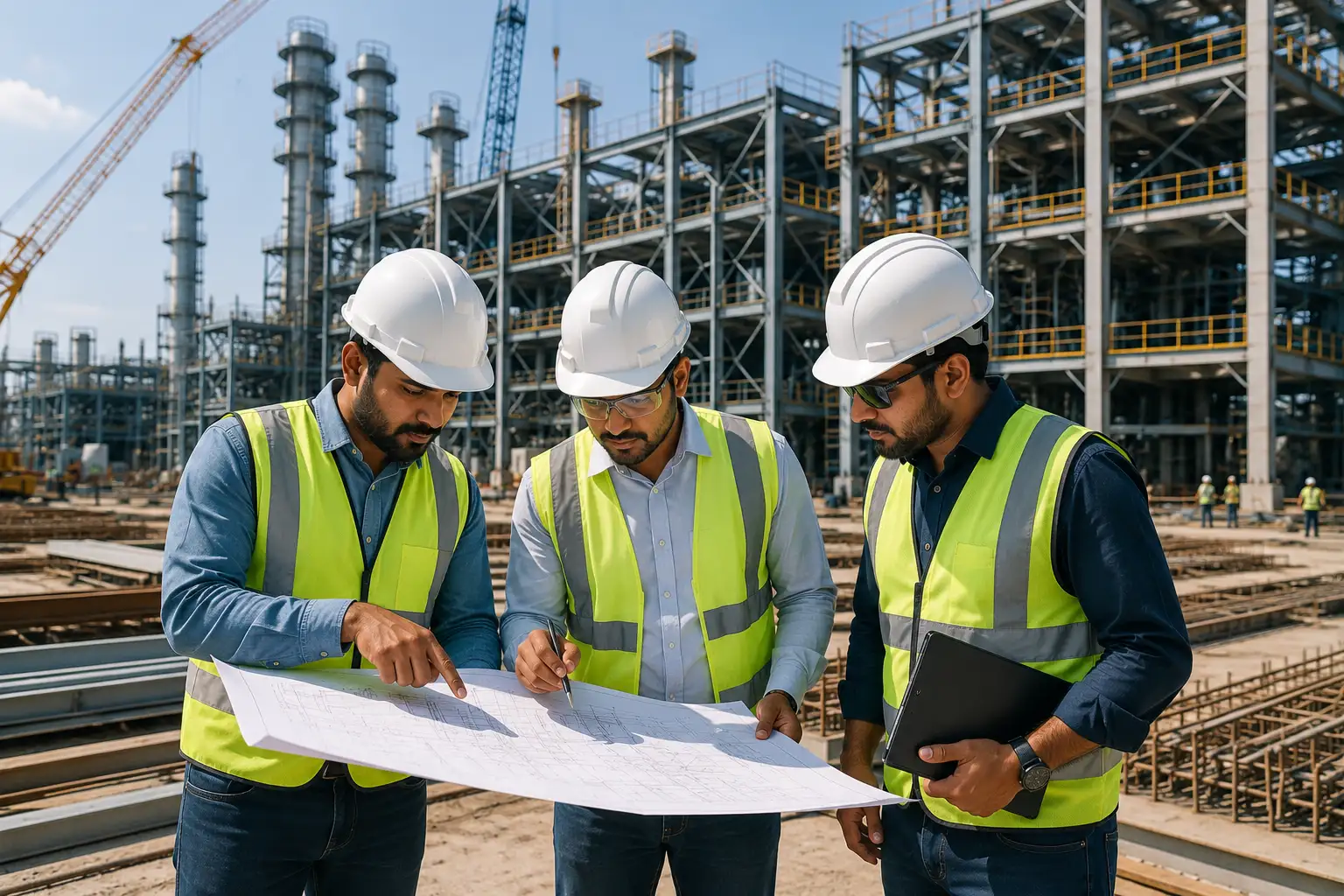
Engineering consultants perform detailed risk assessments during the planning stage, allowing project owners to implement preventive measures before construction begins.
This proactive approach reduces the likelihood of expensive redesigns, project interruptions, and contractual disputes.
6. Digital Engineering Improves Accuracy and Efficiency
Modern engineering consultancy has evolved far beyond traditional 2D drawings. Today, digital engineering technologies help deliver more accurate, coordinated, and efficient projects.
Building Information Modeling (BIM)
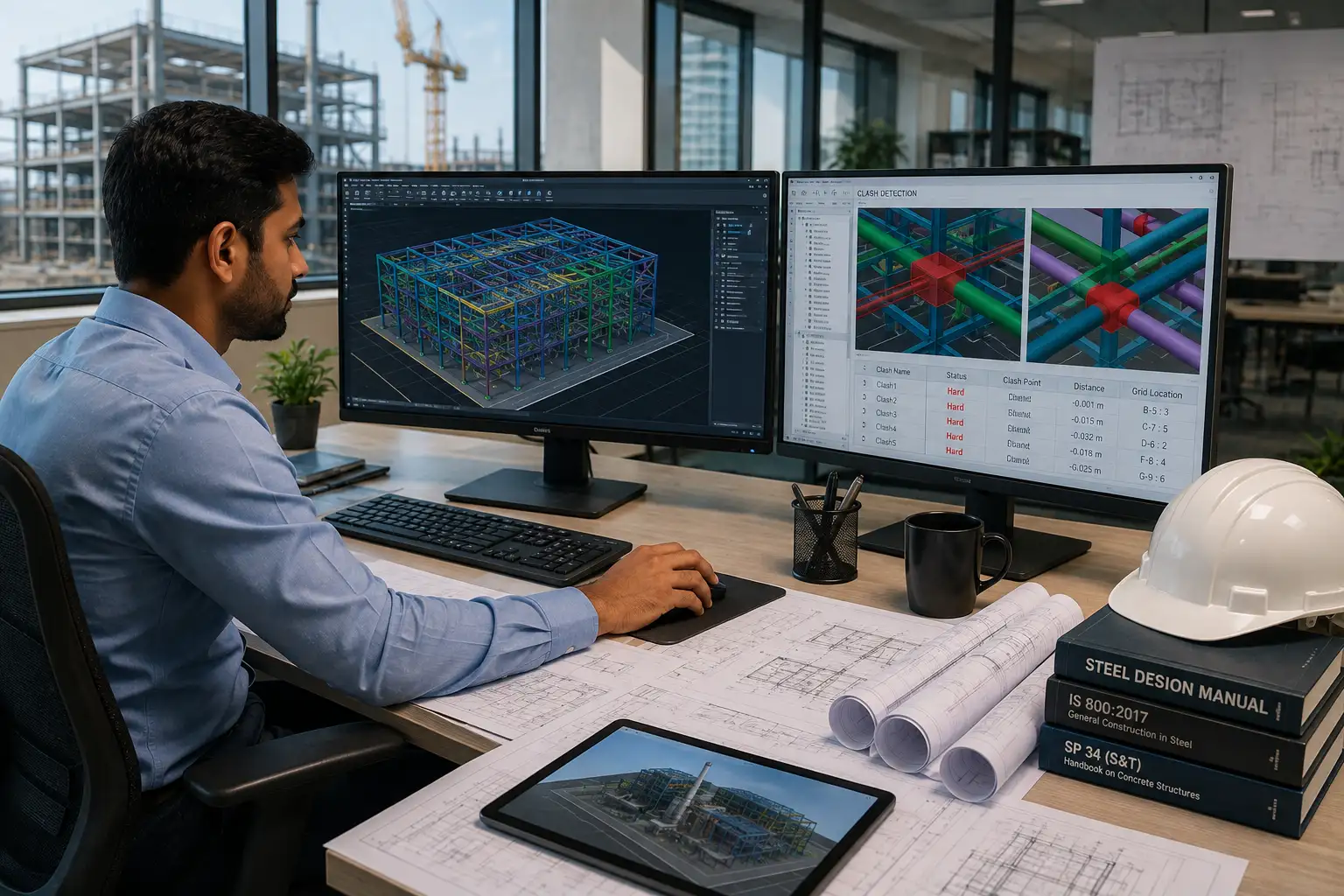
BIM creates an intelligent 3D model that integrates architectural, structural, and MEP systems into a single digital environment.
This allows engineers to:
- Detect clashes before construction
- Improve coordination
- Reduce rework
- Enhance communication between stakeholders
- Improve project scheduling
3D Structural Modeling
Three-dimensional structural models provide accurate visualizations of industrial facilities, enabling better fabrication planning and installation accuracy.
Structural Analysis Software
Advanced analysis software simulates:
- Wind loads
- Earthquake forces
- Dynamic equipment loads
- Crane loads
- Temperature effects
These simulations ensure structures remain safe while avoiding excessive overdesign.
Quantity Estimation
Digital engineering tools automatically generate accurate Bills of Quantities (BOQs), helping procurement teams order the correct amount of materials and reducing waste.
7. Engineering Consultancy Throughout the Project Lifecycle
The value of engineering consultancy extends across every phase of an industrial project.
| Project Phase | Engineering Consultancy Contribution |
|---|---|
| Feasibility Study | Technical evaluation, cost estimation, risk analysis |
| Concept Design | Preliminary layouts and engineering solutions |
| Detailed Engineering | Structural calculations, drawings, specifications |
| Procurement | Technical evaluation of vendors and materials |
| Construction | Site support, inspections, technical guidance |
| Commissioning | Final verification, documentation, quality assurance |
| Operation | Maintenance planning and future expansion support |
This end-to-end involvement ensures continuity, technical consistency, and better project outcomes.
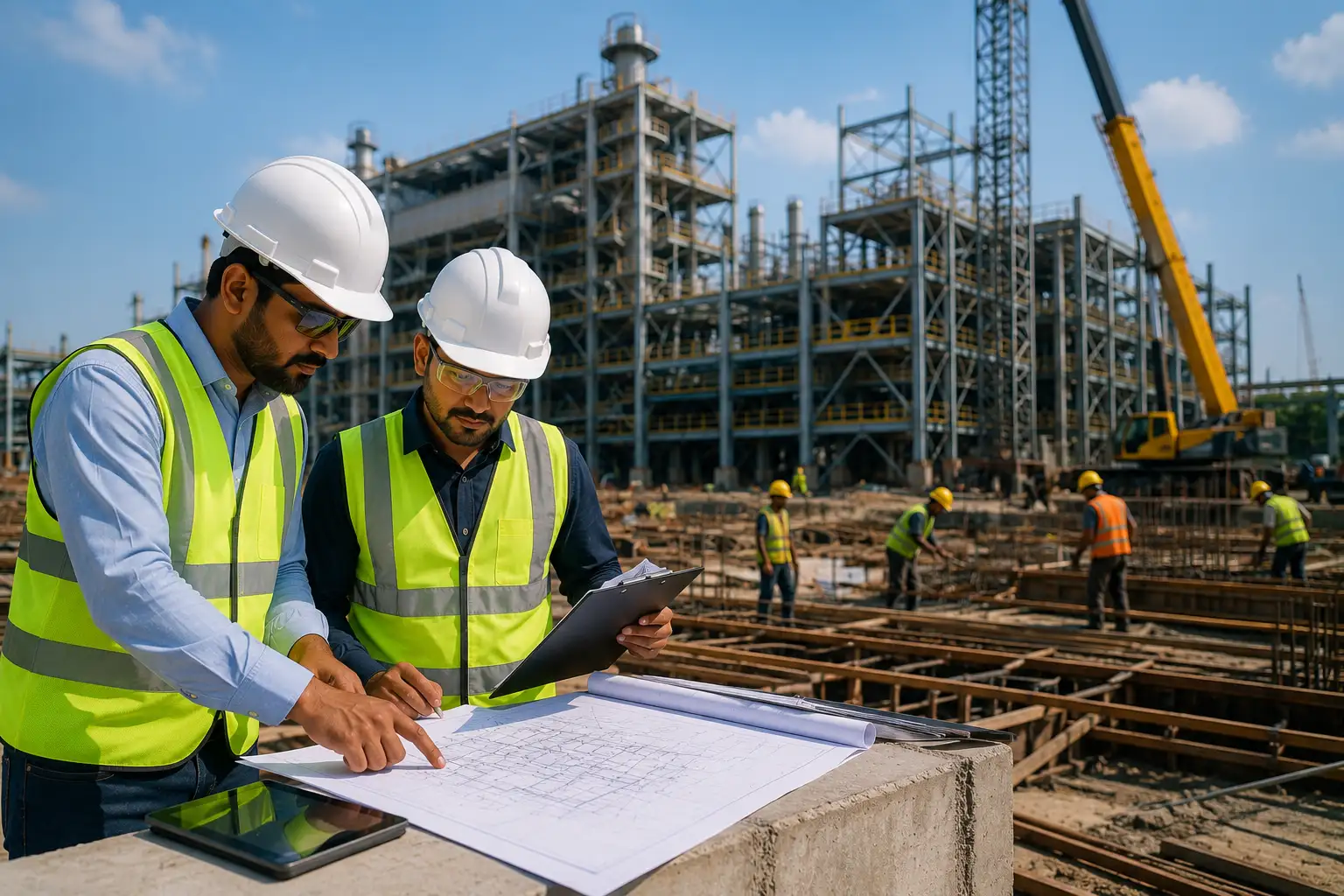
8. Industries That Benefit Most from Engineering Consultancy
Engineering consultancy is essential across a wide range of industrial sectors, including:
Steel Plants
Heavy industrial structures require specialized engineering to support cranes, furnaces, and process equipment safely and efficiently.
Power Plants
Power generation facilities demand precise structural analysis, equipment integration, and compliance with stringent safety standards.
Cement Plants
Engineering consultants optimize layouts, foundations, and material handling systems to improve operational efficiency.
Manufacturing Facilities
Well-planned factory layouts enhance workflow, improve productivity, and support future expansion.
Warehouses and Logistics Parks
Engineering consultancy helps maximize storage capacity, optimize structural spans, and reduce construction costs.
Industrial Townships
Large-scale developments benefit from integrated planning, infrastructure coordination, and phased project execution strategies.
Engineering Consultancy: Cost vs. Value
Many businesses hesitate to hire engineering consultants because they view consultancy fees as an additional expense. In reality, professional consultancy is an investment that delivers measurable financial returns.
| Without Engineering Consultancy | With Engineering Consultancy |
|---|---|
| Frequent design revisions | Optimized designs from the start |
| Material wastage | Efficient material utilization |
| Construction delays | Better planning and scheduling |
| Higher project risks | Proactive risk management |
| Poor coordination | Integrated multidisciplinary design |
| Cost overruns | Better budget control |
| Compliance issues | Regulatory compliance from day one |
| Difficult future expansion | Expansion-ready designs |
The cost of correcting engineering mistakes during construction is often many times higher than the cost of professional consultancy during the planning phase.
Why Businesses Choose Professional Engineering Consultancy
Successful organizations understand that engineering decisions influence every aspect of project performance.
Professional engineering consultancy offers:
- Better planning
- Lower lifecycle costs
- Improved structural safety
- Faster project execution
- Better coordination between disciplines
- Higher construction quality
- Reduced financial risks
- Greater operational efficiency
- Long-term asset reliability
As industrial projects become increasingly complex, the role of engineering consultants continues to grow in importance.
Frequently Asked Questions (FAQs)
1. What is engineering consultancy?
Engineering consultancy involves providing professional engineering expertise for planning, designing, analyzing, and managing industrial and infrastructure projects.
2. How does engineering consultancy reduce project costs?
By optimizing designs, improving material utilization, preventing design errors, reducing rework, and enhancing construction planning.
3. When should an engineering consultant be hired?
Ideally during the project planning and feasibility stage to maximize cost savings and minimize technical risks.
4. What industries require engineering consultancy?
Steel plants, power plants, manufacturing facilities, warehouses, logistics parks, cement plants, pharmaceutical facilities, and industrial infrastructure projects.
5. What is value engineering?
Value engineering is a structured process that improves project performance while reducing unnecessary costs without compromising safety or quality.
6. How does BIM support engineering consultancy?
BIM improves design coordination, detects clashes, enhances visualization, and reduces construction errors.
7. Can engineering consultancy help reduce project delays?
Yes. Proper planning, coordinated designs, and technical documentation minimize construction interruptions and decision-making delays.
8. Why is structural optimization important?
Structural optimization reduces material consumption, lowers construction costs, and improves overall project efficiency while maintaining safety.
9. Is engineering consultancy only for large projects?
No. Projects of all sizes benefit from professional engineering expertise, although the financial impact is especially significant for medium and large industrial developments.
10. Why choose Shiva Consultancy Services Pvt. Ltd.?
Shiva Consultancy Services Pvt. Ltd. offers comprehensive engineering consultancy solutions backed by technical expertise, industry experience, and a commitment to delivering safe, efficient, and cost-effective industrial projects.
Conclusion
Industrial projects demand precision, strategic planning, and informed technical decision-making. While the visible costs of construction often receive the most attention, the greatest opportunities for savings lie in the engineering and planning stages. Every optimized design, every prevented error, and every well-informed decision contributes directly to project profitability.
Engineering consultancy is far more than a design service. It is a strategic partnership that helps businesses reduce risks, improve efficiency, optimize resources, and maximize long-term value. From feasibility studies and structural engineering to construction support and lifecycle planning, professional engineering consultants ensure that projects are delivered safely, efficiently, and within budget.
For businesses planning industrial facilities, manufacturing plants, warehouses, power projects, or large infrastructure developments, investing in expert engineering consultancy is one of the smartest financial decisions they can make.
About Shiva Consultancy Services Pvt. Ltd.
Shiva Consultancy Services Pvt. Ltd. provides comprehensive engineering consultancy solutions for industrial and infrastructure projects across India. Our expertise spans structural engineering, detailed engineering, industrial plant design, project planning, value engineering, and technical consultancy. By combining engineering excellence with practical industry experience, we help clients optimize costs, reduce project risks, and deliver sustainable, high-performance facilities that stand the test of time.
Planning your next industrial project?
Partner with Shiva Consultancy Services Pvt. Ltd. for expert engineering consultancy services that deliver smarter designs, optimized costs, and successful project execution. Contact our team today to discuss how we can support your project from concept to completion.
Next Article : PEB Companies in Delhi NCR India
Follow us on LinkedIn – Shiva Group