
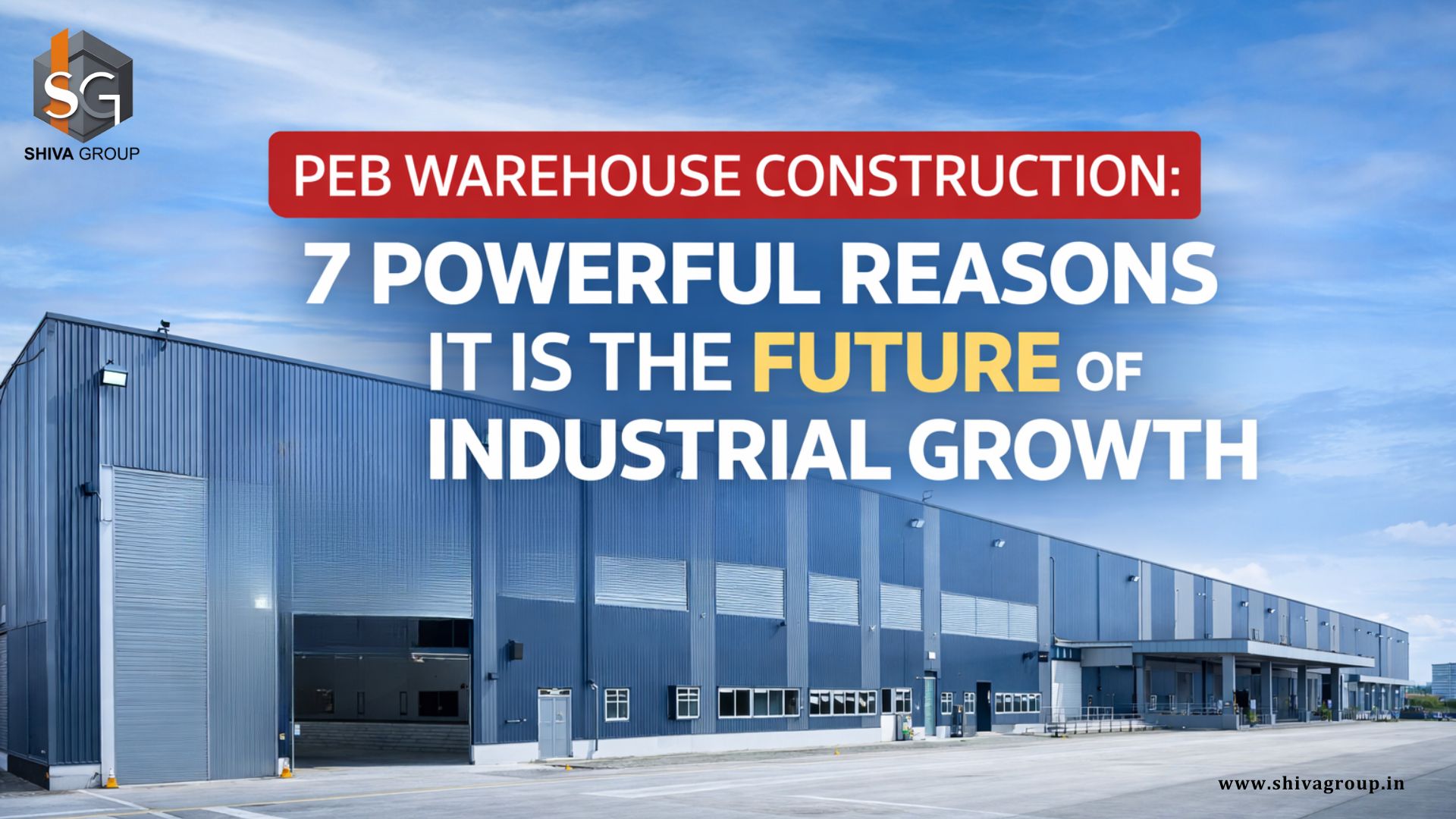
Introduction to PEB Warehouse Construction
PEB Warehouse Construction is rapidly redefining the way industrial warehouses are designed and executed across India. With the rise of manufacturing, logistics hubs, e-commerce expansion, and industrial corridors, the need for modern, efficient, and scalable warehouses has never been higher.
Traditional construction methods often struggle with long timelines, cost escalation, and structural limitations. In contrast, PEB Warehouse Construction offers precision engineering, faster installation, and optimized structural performance.
This shift is not temporary. It reflects a long-term transformation in industrial infrastructure planning.
Growing Demand for Modern Warehousing in India
India’s industrial and logistics sectors are expanding at a significant pace. The growth of organized retail, export-import activity, and dedicated freight corridors has increased the demand for robust storage solutions.
Modern warehouses must offer:
Large storage capacity
Efficient material handling systems
High structural safety standards
Long operational life
Low maintenance costs
PEB Warehouse Construction directly addresses these requirements, making it the preferred choice for industrial developers and investors.
1. Faster Project Completion
Speed is one of the strongest advantages of PEB Warehouse Construction.
Unlike conventional RCC buildings, PEB components are designed and fabricated in controlled factory environments. The structural members, roofing systems, and secondary components arrive at the site ready for assembly.
This significantly reduces:
On-site construction time
Labor dependency
Weather-related delays
Faster project execution means earlier operational start. For logistics companies and manufacturers, this translates into quicker revenue generation and reduced financial risk.
2. Lower Construction and Operational Cost
Cost optimization plays a major role in infrastructure planning. PEB Warehouse Construction offers clear financial advantages.
Steel structures are designed using advanced engineering software that ensures optimized material usage. This reduces wastage and unnecessary load on foundations.
Key cost benefits include:
Reduced foundation cost due to lighter structural weight
Lower labor requirement
Minimal material wastage
Controlled fabrication expenses
In addition to construction savings, operational costs are also lower because of energy-efficient designs and minimal maintenance needs.
3. Large Clear Span and Space Optimization
Warehouses require uninterrupted floor space for efficient storage and movement.
PEB Warehouse Construction allows large clear spans without internal columns. This ensures:
Better storage layout
Easy forklift movement
Efficient racking system installation
Higher usable area
The flexibility in design allows customization of height, width, and length according to operational requirements. This makes PEB ideal for high-capacity industrial storage facilities.
4. Strength, Stability, and Long-Term Durability
Modern PEB Warehouse Construction is engineered to withstand extreme conditions.
High-grade structural steel is used to ensure resistance against:
Wind loads
Seismic activity
Heavy roof loads
Harsh environmental conditions
Protective coatings prevent corrosion, ensuring longer structural life. When designed properly, PEB warehouses can deliver decades of reliable performance.
This level of durability makes them a dependable asset for industrial investors.
5. Flexibility and Easy Future Expansion
Industrial growth often demands expansion. Businesses rarely remain static.
One of the biggest strengths of PEB Warehouse Construction is scalability. Additional bays can be added easily without disturbing the existing structure.
This allows:
Smooth operational continuity
Reduced reconstruction cost
Long-term flexibility
Such adaptability makes PEB a future-ready solution.
6. Energy Efficiency and Sustainability
Energy efficiency is becoming a priority in modern industrial infrastructure.
PEB Warehouse Construction supports multiple sustainable features:
Natural daylight panels
Insulated roofing systems
Ridge ventilators
Solar panel compatibility
Rainwater harvesting integration
These features reduce electricity consumption and improve internal working conditions. Lower energy usage leads to long-term cost savings.
Sustainability is not just an environmental choice. It is a smart financial decision.
7. Reduced Maintenance and Lifecycle Benefits
Maintenance cost directly affects profitability.
Traditional buildings may develop cracks, settlement issues, and structural wear over time. PEB Warehouse Construction, on the other hand, ensures:
Better load distribution
Reduced structural stress
Lower risk of major repairs
The lifecycle cost of PEB warehouses is significantly lower compared to conventional structures.
Technical Components of PEB Warehouse Construction
To understand why PEB Warehouse Construction performs so efficiently, it is important to look at its key components:
Primary framing (columns and rafters)
Secondary members (purlins and girts)
Roofing and cladding systems
Bracing systems
Insulation layers
Mezzanine floor options
Each component is precision-engineered to work as an integrated structural system.
PEB vs Conventional Warehouse Construction
When comparing PEB Warehouse Construction with conventional RCC construction, the differences are clear:
| Factor | PEB Warehouse Construction | Conventional Construction |
|---|---|---|
| Construction Time | Faster | Slower |
| Cost Control | High | Moderate |
| Expansion | Easy | Complex |
| Maintenance | Low | Higher |
| Structural Weight | Lighter | Heavier |
| Energy Efficiency | Better | Moderate |
This comparison explains why industries are shifting toward PEB systems.
Industries Benefiting from PEB Warehouse Construction
Several industries are adopting PEB Warehouse Construction, including:
Logistics and supply chain companies
E-commerce fulfillment centers
Automobile manufacturing
FMCG storage units
Pharmaceutical warehouses
Cold storage facilities
Industrial manufacturing units
The adaptability of PEB design makes it suitable across sectors.
Why Shiva Group is a Reliable Partner for PEB Warehouse Construction
Shiva Group brings strong technical expertise and practical industry experience in industrial infrastructure development.
Our approach to PEB Warehouse Construction includes:
Detailed structural planning
Advanced design optimization
Quality-controlled fabrication
Timely site execution
End-to-end project management
We focus on delivering warehouse structures that are efficient, durable, and aligned with operational needs.
At Shiva Group, we believe infrastructure is not just about building structures. It is about building long-term industrial value.
Final Conclusion
PEB Warehouse Construction represents the future of industrial infrastructure. It combines speed, cost efficiency, structural strength, scalability, and sustainability in one integrated solution.
As India continues its industrial expansion, the demand for reliable and efficient warehousing will grow further. Businesses that choose PEB Warehouse Construction today are investing in smarter, future-ready infrastructure.
With the right technical expertise and execution partner, a PEB warehouse becomes more than a building. It becomes a strategic asset for long-term growth.
Shiva Group stands committed to delivering high-quality PEB Warehouse Construction solutions that support industrial progress and operational excellence.
Frequently Asked Questions About PEB Warehouse Construction
1. What is PEB Warehouse Construction?
PEB Warehouse Construction refers to the process of designing and building warehouses using pre-engineered steel components that are manufactured in factories and assembled at the project site. This method ensures faster execution, cost efficiency, and structural durability compared to traditional construction.
2. Why is PEB Warehouse Construction better than conventional construction?
PEB Warehouse Construction offers faster completion time, lower cost, large clear span design, easy expansion, and reduced maintenance. Conventional RCC construction generally requires longer timelines and higher material usage.
3. How long does PEB Warehouse Construction take?
The timeline for PEB Warehouse Construction depends on the size and design complexity. However, it is typically 30 to 50 percent faster than conventional warehouse construction because structural components are pre-fabricated.
4. Is PEB Warehouse Construction durable?
Yes. PEB Warehouse Construction uses high-grade structural steel designed to withstand wind loads, seismic forces, and heavy operational loads. With proper coating and maintenance, these warehouses can last for decades.
5. Can a PEB warehouse be expanded in the future?
One major advantage of PEB Warehouse Construction is scalability. Additional bays and extensions can be added with minimal structural disruption, making it ideal for growing businesses.
6. Is PEB Warehouse Construction energy efficient?
Yes. PEB warehouses support insulation systems, natural lighting panels, ventilation systems, and solar panel integration. These features reduce energy consumption and operational costs.
7. Which industries benefit most from PEB Warehouse Construction?
Industries such as logistics, e-commerce, FMCG, automobile manufacturing, pharmaceuticals, and industrial manufacturing benefit significantly from PEB Warehouse Construction due to its flexibility and cost efficiency.